Showing posts with label Survey Says. Show all posts

Sunday, June 21, 2009

Survey Says . . .

Best places to experience Art Deco in Cincinnati (and nearby).

Top 6 answers on the board . . .

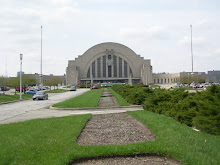
1. Union Terminal (1933)
Architect: Fellheimer & Wagner w/ Paul Cret
It goes without saying Union Terminal is No. 1.

2. Downtown (and Over the Rhine)
Downtown has a nice collection of Art Deco and Art Modern including the former Lazarus Department Store (1938, renovation), Carew Tower & Omni Netherlands Plaza Hotel (1932), Cincinnati Bell (1930), the Times Start Building (1933), and the America Building (1928) in Over the Rhine

3. Walnut Hills & East Walnut Hills
Start off at Krohn Conservatory (1933) and then head north in to Walnut Hills for some nice Art Deco and early modernism like the Paramount Theatre Building (1931), Apartment Complex at 2531 - 2521 Kemper Lane (1928 with later additions), Cleinview Apartments (1928), International Molders & Allied Workers Union Building (1950), Apartment Building at Salutarius Avenue & East McMillan Street, an old roller rink, and the United Way Community Chest, formerly Ohio National (1933, renovation)

4. 20th Century Movie Theatre (1941)
3021 Madison Road
Architect: Fred Stritzel

5. Xavier’s Coca Cola Bottling Plant (1938) & University of Cincinnati’s Wilson Auditorium (1931)
Architects: John H. Deekin (former); Fechheimer & Ihorst (later)

6. Old Municipal Building, Hamilton, Ohio (1935)
20 High Street, Hamilton, OH
Architects: George Barkman, R. E. Smith, Frederick G. Mueller and Walter R. Hair

This Father’s Day post is dedicated to my father who worked in the City of Hamilton Municipal Building from 1958 to his retirement in 1989. To a large degree I point to this building (and Season 2 of This Old House) as really fueling my interest in architecture as a child. It was probably the first public building I experienced in person (as opposed to just in photographs) on an ongoing basis that I had a strong reaction to and fell in love with. Call me a nerd, but yes, you can fall in love with a building.

Honorable mentions include Lunken Airport (1937) and Westwood including their cute library branch (1931 by Architect Stanley Matthews) and a number of nice apartment buildings.

References:
Painter, Sue Ann. Architecture of Cincinnati. Athens, OH: Ohio University Press, 2006

Tuesday, March 3, 2009

Survey Says . . .

The best crepes at It’s Just Crepes (as judged by me).

Top 6 answers on the board . . .

1. Mediterranean w/ Chicken*
Chicken, Feta, Olives, Tomato, Green Pepper, Oregano
* Note: Standard ‘Mediterranean’ does not come with chicken.

2. Cordon Bleu
Swiss, Chicken, Ham, Honey Mustard
3. Club
Swiss, Turkey, Bacon, Tomato, Ranch Dressing

4. Good Morning
Cheddar, Ham*, Egg
* Note: This is good with bacon in lieu of ham too.

5. Buffalo
Blue cheese, Chicken, Buffalo sauce

6. Hawaiian*
Cheddar, Ham, Pineapple, Brown Sugar, Soy Sauce
* Note: This is my friend’s 2nd favorite crepe after the Cordon Blue so I thought I should add it even though I do not like pineapple.

This post is in honor of It’s Just Crepes new expanded hours Monday through Saturday and the all new Sunday hours that started on Monday, March 2.

Located at 39 E. Court Street Downtown, the hours of operation are now:
Monday – Friday: 7:30 AM – 8:00 PM
Saturday: 9:00 AM – 8:00 PM
Sunday: 9:00 AM – 2:00 PM

A couple of things in closing . . .
  • It’s Just Crepes also has sweet crepes but I have never had any.
  • You can check ‘em out on Facebook
  • Get a “Crepe Fan Card” and after your ninth crepe, your tenth one is free.

Wednesday, July 9, 2008

Survey Says . . .

The least successful (as determined by me) buildings downtown.

Top 6 answers on the board . . .

1. Chiquita Brands International Building (1985)
Northwest corner 5th & Sycamore Streets
2. Center at 600 Vine (1984)
3. Millennium Hotel (1968 & 1977)
Northeast corner 5th & Elm Streets
4. Federal Reserve Bank (1972)
Northwest corner 4th and Main Streets
5. Monroe Tire (1968)
Southwest corner Central Parkway & Walnut Street
6. 630 Main Street (1960)
Honorable mentions would include the Court Street Center (Renovated 1985), Cincinnati Bell Addition (1975) and maybe the Cincinnati & Hamilton County Library (1955, Additions 1982 & 1997).
I thought "worst" was too harsh. And "ugly" not accurate. But these buildings are those that I just do not think are good urban buildings. By that I mean they generally are not built to the street right of way and the public sidewalks, do not offer much to the public right of way, or are more typically "suburban" in their development or site planning. I did not include any parking garages as I covered those in an older post although a couple of them might be the worst of the worst. I also tried not to focus on the actual architecture as it is mostly subjective. I looked at form, scale, orientation, access, etc. and tried to not look at the aesthetic qualities. Although I will admit, the architecture is a factor on some of them.

Many of the buildings on the list were a result of the Block Plan of 1964 (Chiquita, Millennium, Federal Reserve Bank) and from about the same time period (Center at 600 Vine). They are large buildings with setbacks and/or plazas that, while common of the time period, in my opinion are not successful at street level. I hate plazas or setbacks with no real purpose or that do not compliment the public realm. A set back at a church or large public building is understandable. (Though, I still wonder if the Aronoff Center or even P&G should be listed in the unsuccessful category.) But I just don’t think a bunch of paving with some modern sculpture or fountain always makes for great public space. It is just wasted space. Oh, and Millennium is just bland and ugly.

The Federal Reserve Bank fails in my opinion by its treatment and orientation away from 5th Street. One may not like the architectural style, however it is at least consistent and the 4th Street façade and loggia do engage the street. However it gives nothing to 5th Street and Government Square except a restricted use park. Government Square would be a much improved as a public place if it was enclosed more by a building on its south edge. It simply erodes to the south now and is honestly in my opinion only vaguely recognizable as a "Square" anymore.

Monroe Tire is a development model of the suburbs yet in the Central Business District: a building (one-story to boot in this case) at the back of a lot and parking in front. (See Court Street Center too.) It serves the customer but doesn’t serve the city particularly well. I think this site is particularly interesting as it will be on the streetcar line and I’d love to see a more intense land use at some point. However, Artworks is putting a mural on the north side of the neighboring building (ACT). No offense, but I actually hope it gets covered by a new building some day. Note: The Goodyear Station at 317 E. 9th is similar yet is much older (1932) and does abut the sidewalk along Cheapside and part of 9th Street which is why Monroe is listed and not Goodyear.

630 Main Street has a singular design aesthetic but for the life of me I cannot understand why it is set back from all other buildings on the east side of the street. It just bugs me. It is such a great block too, save for that.

You will notice very few older buildings on the list. While some like 118 East 9th Street (1875) and 616 Race Street (ca. 1865 and later) need a little cosmetic help their form, orientation and scale are usually adequate and respectful. The "bones" are good; they just need a little façade improvement.

So you may ask why the Library shows up as a dishonorable mention. Well, while I get the "building in a park" concept, I just feel the addition north of 9th street has too much wasted space around it and dilutes the whole assembly. It replicates the gardens at 9th and Vine Streets and adds another surface parking lot at 9th and Walnut Streets.

Anyway, just my opinion.

Wednesday, May 28, 2008

Survey Says . . .

Best places to experience the architecture of James Keys Wilson in Cincinnati.

Top 6 answers on the board . . .

1. Plum Street Temple (1866)
8th & Plum Streets

Stunning and unique and the reason why it is No. 1.

2. Spring Grove Cemetery including Gatehouse and Office (1863) and Dexter Mausoleum (1869)
4521 Spring Grove Avenue
3. "Scarlett Oaks"Schoneberger House, Clifton (1870)
440 Lafayette Avenue
4. "Woodburn"John S. Baker House, East Walnut Hills (1854)
1887 Madison Road
Wilson lived nearby and married in to the Keys family. John Baker was the father-in-law of his wife's brother Samuel, who also lived nearby (and whos house he also designed). Keys Crescent which is nearby takes its name from this family. It is speculated that Wilson adopted his wife's family name for business reasons.

5. The Samuel Allen House, Glendale (1859)
25 West Fountain Avenue
Wilson eventually lived in Glendale and was one of Glendale's incorporators in 1851.

6. 4th Street including Mitchell & Rammelsberg Furniture Co. (1870) - future part of McAlpin’s Department Store & Herschede Building (1857)

James Keys Wilson was born in Cincinnati in 1828. He began his practice in approximately 1848 at the age of 20 upon his return from his training in Philadelphia and New York (under Martin E. Thompson and then James Renwick, Jr., designer of the Smithsonian Castle). From approximately 1851 to 1863 he partnered with William Walter. Walter would go on to partner with William Stewart and they designed many Cincinnati buildings including Mother of God in Covington (1871) and Covenant First Presbyterian (1875). Both James McLaughlin & Charles Crapsey also studied with Wilson before starting their own practices.

After about 1870, Wilson does not appear to have done much work, or at least large commissions. He does serve as the first President of the Cincinnati Chapter of the American Institute of Architects (AIA) from 1870 to 1871 and again from 1872 to 1873. Cincinnati was in fact the 2nd Chapter of the AIA in the nation. A nice article in the "Journal of the Society of Architectural Historians "speculates, for whatever reason, he fell out of favor to architects like Samuel Hannaford and James McLaughlin.

An important work not in Cincinnati by Wilson is the Bethany College Old Main & Commencement Hall (1858 - 1871) in Bethany, West Virgina. It along with Plum Street Temple and Spring Grove Cemetery are National Historic Landmarks. A tremendous accomplishment.
James Keys Wilson died on Oct. 21, 1894 and is buried in Spring Grove – Section 49; Lot 1, Space 6. As far as I can tell, there is no headstone. His daughter is also buried in the family lot and does have a simple marker.

References:
Patton, Glen. James Keys Wilson (1828-1894): Architect of the Gothic Revival in Cincinnati "The Journal of the Society of Architectural Historians", Vol. 26, No. 4 (Dec., 1967), pp. 285-293. Clubbe, John. Cincinnati Observed: Architecture & History. Ohio State University Press, Columbus. 1992
Langsam, Walter. Great Houses of the Queen City. Cincinnati Museum Center, Cincinnati. 2002.
Historic images from the Library's Cincinnati Memory Project and the West Virginia Archives & History.