
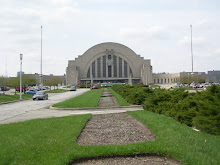
 The last day of the Duke Energy Holiday Train Display at the Duke Energy Building (1930) by John Russell Pope in association with Garber & Woodward.
The last day of the Duke Energy Holiday Train Display at the Duke Energy Building (1930) by John Russell Pope in association with Garber & Woodward.
The last day of the Duke Energy Holiday Train Display at the Duke Energy Building (1930) by John Russell Pope in association with Garber & Woodward.


 Samuel Hannaford's sons Charles and Harvey completed a number of schools for CPS including Winton Place Academy (1910), Carson (1916), Condon (1922), and Hoffman (1925) which is also on the National Register and has a fantastic setting on Darrell Ave in Evanston/Walnut Hills. (I leave the right to select it for an upcoming post.)


 The building is very large at over 100,000 square foot. When built it had ". . . a modern Kindergarten, 46 classrooms, a Metal Shop, an Electric Shop, a Print Shop, a Woodworking Shop, a Mechanical Drawing Room, 2 Cooking Rooms, 2 Sewing Rooms, a Library, 2 Gymnasiums, an auditorium seating 550, and a Lunch Room." It and the playgrounds and a swimming pool occupy a city block in Lower Price Hill which unfortunatly is set on a tight site in a sea of asphalt paving. The building is still occupied and is slated for renovation in an upcoming CPS Master Plan segment.


References:
Flischel, Robert. An Expression of the Community. Cincinnati: The Art League Press, 2001.
Olyer School History from their website.
Historic photos from Library's Cincinnati Memory Project.


 Now, there is already a nice collection of buildings on that site. They all need a little work but there is a lovely Italianate building at 819 - 821 Elm Street with a decorative cornice and hooded lintels over the windows. The auditor's website indicates the date of the building as 1879. Around the corner facing Ninth the last portion of the complex appears to me to be an older Greek Revival with a simpler roofline, cornice and flat, unadorned lintels over the punched openings.
 The building is included in the Ninth Street Historic District. From the City's website:
"The Ninth Street Historic District is a cohesive assemblage of 19th and early 20th century urban architecture in Cincinnati and is also important as a representation of the 19th century 'walking city' environment. Diverse samples of the Greek Revival, Italianate, and Queen Anne styles are included. The area around Ninth Street consists primarily of single-family dwellings, with a mixture of shops, churches, and boarding houses."
 The collection of buildings are for sale by Sibcy Cline for $335,000 with a pending offer.
The new building, for Towne Properties and as indicated on GBBN's website, "is a new infill condominium project in the central business district of Cincinnati. The project consists of 18 entry level condominiums ranging in size from 900sf to 1200sf units and secure parking on the first floor for 18 cars."
 While I like seeing more density downtown, I wish it wasn't at the expense of some of our historic buildings, especially on a street lined with such marvelous buildings. Is there a way to at least keep the Italianate building on the corner? Or what about buying the ugly building across the street and build there . . . Heck, there is a whole parking lot along Ninth in which one could build.
 I am not sure what is the status of this project. Maybe it was just study. I am going to keep my eye on it. And maybe Kevin at Building Cincinnati can look in to it.
.jpg)

 Holiday display at
